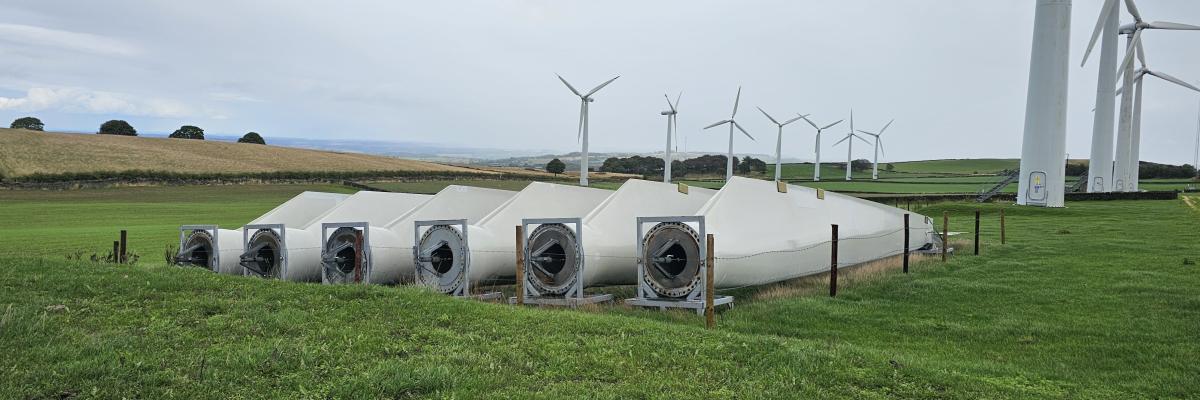
Telos rates gearboxes, main bearings, towers and other high-value components turbine by turbine, so owners know what can be sold or kept as spares before decommissioning begins.
Windfarm owners planning for decommissioning can now find out how much working life remains in each turbine’s major components before anything is dismantled.
Telos, a new condition assessment introduced by wind turbine decommissioning specialist Reblade, rates components such as gearboxes, main bearings, shafts and towers on every turbine individually. Owners can use the results to sell components with life left in them or keep them as spares for their own fleet, and give planners, regulators and investors a documented account of what happened to each one.
Keeping working components in use matters well beyond the site being decommissioned. Many older windfarms run on turbine models that are no longer manufactured, and replacement parts for them are often expensive, slow to obtain or no longer made at all.
As more of these sites reach the end of their consented life, the components removed from them become an increasingly important source of spares for the turbines of the same type that are still generating. A rated gearbox or main bearing can keep another windfarm running for less than the cost of a new replacement and without the wait, while the revenue from its sale can help offset the cost of decommissioning for the owner selling it.
Telos, which stands for Turbine End-of-Life Options Service, joins Reblade’s suite of material recovery and reuse solutions. It sits alongside BladeBoard®, Reblade’s structural composite made from end-of-life turbine blades, which is a finalist in the Best Innovation Award – New Technology Products category of the Scottish Green Energy Awards, taking place on 3 December.
Fiona Lindsay, CEO of Reblade, said: “Owners are under growing pressure to account for what happens to every part of a windfarm at the end of its life, and too often valuable components go for scrap without anyone checking whether they have more to give.
“Telos gives owners the evidence to make that decision component by component, and a route to market for the parts worth selling. Alongside BladeBoard, it shows how far Reblade’s work now extends beyond removing turbines safely, into recovering as much value from them as possible.”
Turbines on the same site wear at different rates, so some components keep years of working life even when the windfarm, as a whole, has reached the end of its operational life. Telos assesses every turbine on a site individually, using multiple data sources including turbine telemetry, onsite weather conditions and Reblade’s in house operational experts to calculate the fatigue each major component has accumulated and the life it has remaining.
Gearboxes, main bearings, shafts, bedplates, pitch and yaw systems and towers are each given a condition rating, with the cost of removing them intact factored in. Owners can then keep rated components as spares for their own fleet or sell them through Reblade’s resale network.
Where a component does not find a buyer, the owner has a documented record that resale was tested before the component went for recycling. Telos is available to owners working with Reblade, either during preparation of a Decommissioning & Restoration Plan or where Reblade is appointed as decommissioning contractor.
Reblade’s wind decommissioning solutions will be showcased at a major industry seminar in Spain on 24 November. The End-of-Life Issues & Strategies Seminar (EoLIS 2026) in Bilbao on 24 November will see Dr David Bryce, one of Scotland’s leading researchers in turbine blade recycling, speak about how BladeBoard® turns decommissioned blades into long-life structural products through mechanical recycling.
Now Materials Solutions Manager at Reblade, David will also speak about the economic and environmental benefits of keeping high-value components in use through Telos, before any material goes for recycling. David said: “The most valuable thing you can do with a working component is keep it working. Reuse keeps the materials and energy that went into making a gearbox or a bearing in service, and recycling comes in when that is no longer possible.”